
How Singapore Restaurants Rank on Google Maps: The 2026 Local Pack Playbook
Quick Answer
Singapore restaurants rank in the Google Maps 3-pack through four signals in this order of weight: proximity to the searcher, Google Business Profile completeness, review volume and recency, and local backlink and citation strength. In 2026, reply speed to new reviews and weekly GBP Posts carry more weight than they did two years ago. Nothing beats a complete profile with 200+ photos, 50+ recent reviews, and a reply rate above 90%.
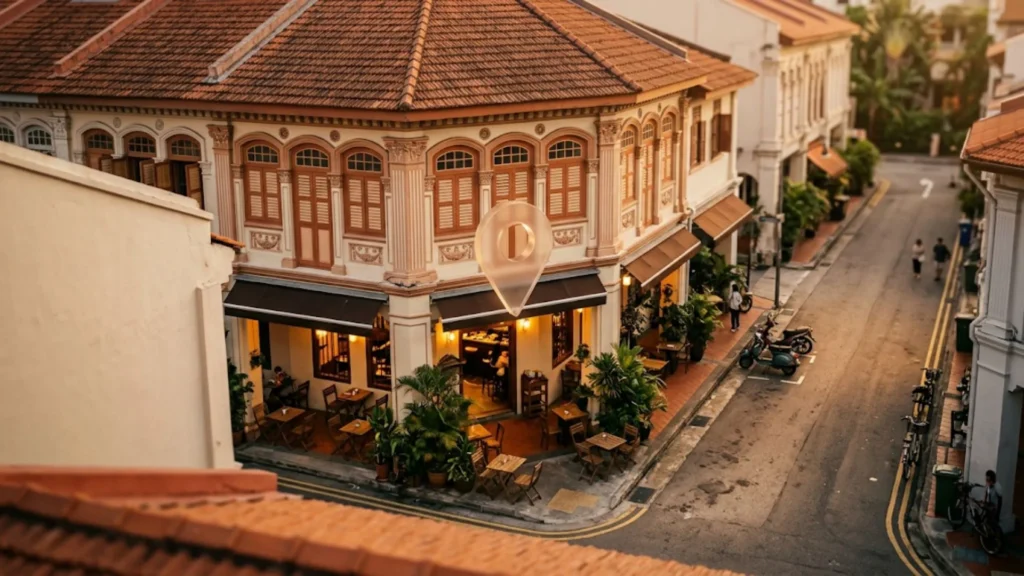
Why Google Maps Rankings Decide Your Dinner Service
Most independent restaurants in Singapore get between 40% and 70% of their new customer discovery from Google Maps and Search, not from Instagram, TikTok, or food blogs. We see this pattern across almost every account we audit. If your restaurant does not sit in the top 3 Maps results when someone searches "Turkish food Kampong Glam" or "ramen Tanjong Pagar", you are invisible to the people most ready to walk in and spend money.
Here is the thing most agencies will not tell you. Google Maps rankings are not a mystery. They are decided by a handful of signals, most of which you can influence inside 90 days.
The Four Signals That Decide Local Pack Rankings in 2026

1. Proximity to the Searcher
The single strongest ranking factor. If a diner is standing in Bugis and searches "halal brunch", Google is biased toward restaurants within walking distance. You cannot change where your restaurant sits on the map. What you can change is how many "near me" searches you win inside your 2 km radius. That comes from the next three signals.
2. Google Business Profile Completeness
A profile that is 100% filled out ranks higher than one at 80%. The fields that actually move the needle:
- Primary category set to the most specific match, for example "Turkish Restaurant" not "Restaurant"
- Up to 9 secondary categories, pulled from your actual menu
- Opening hours accurate including public holidays and Ramadan or festive adjustments
- Services list with every category you offer: dine-in, takeaway, delivery, catering, private events
- Menu items with real prices in SGD
- Products populated with at least 15 signature dishes, each with a photo
- Business description under 750 characters, written for diners, not search engines
3. Review Volume, Recency, and Reply Rate
Review signals got heavier in 2026. We see three sub-factors moving rankings:
- Total review count above 50 is the floor for competitive Singapore searches, 200+ is where top performers sit
- Review recency matters: a profile that gets 5 reviews a week outranks one that got 500 reviews two years ago and nothing since
- Reply rate above 90% within 48 hours is a visible trust signal and correlates strongly with higher rankings
Never buy reviews. Google is actively culling fake review clusters in Singapore right now, and a profile that gets suspended loses six months of ranking equity.
4. Local Backlinks and Citations
Backlinks from Singapore-based food blogs, local directories, and halal or lifestyle publications still matter. The ones that move Maps rankings in 2026:
- TripAdvisor listing claimed and filled out
- Foursquare, Burpple, and HungryGoWhere entries matching your GBP name, address, phone
- Mentions on Singapore food blogs like HoneyCombers, HaveHalalWillTravel, Kaizenaire
- Local Chamber of Commerce or neighbourhood merchant association pages
Our team covers citation building and local link acquisition under the Local SEO service, if the DIY route is not where you want to spend your week.
Google Business Profile Tactics That Still Work in 2026
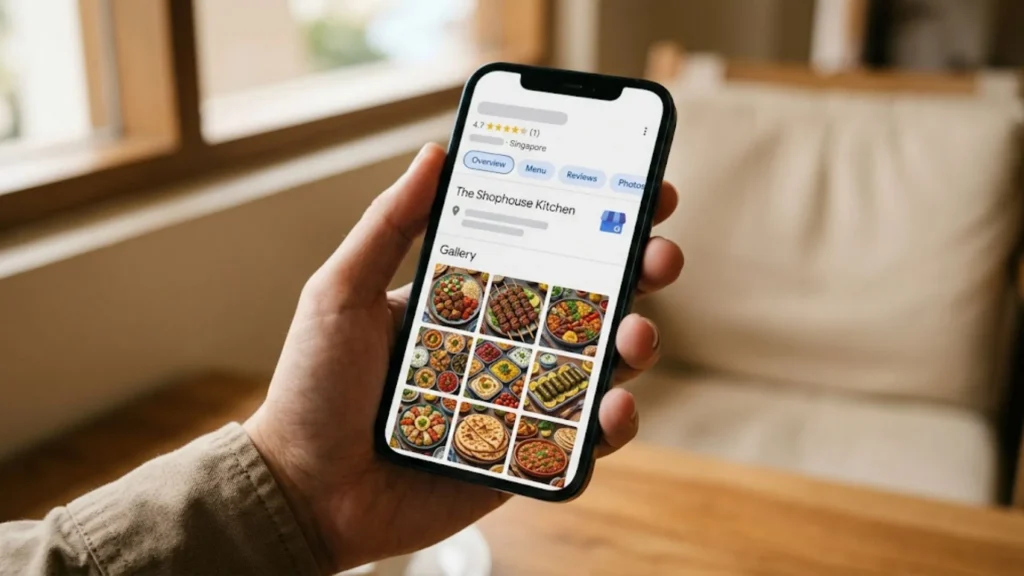
Post Weekly, Not Daily
GBP Posts have a shelf life of 7 days. One post a week, with a real photo and a specific offer or event, is enough. We see no additional lift from daily posting. What matters is consistency over 90 days, not frequency.
Upload Photos Weekly
Add 3 to 5 new photos a week minimum. Google weighs photo recency and total count. A profile with 500 photos ranks higher than one with 50, assuming review signals are comparable. Rotate across food, interior, exterior, team, and customer photos.
Use the Q&A Section Yourself
Nobody tells restaurant owners this, but you can post questions on your own profile and answer them. Seed 10 to 15 common questions covering halal status, dietary options, parking, dress code, booking policy, kids-friendly, and private room availability. This is one of the fastest wins in local SEO right now.
Review Strategy That Moves Rankings

Three practices separate restaurants that rank from restaurants that stall:
- A review ask built into the dining experience, not an afterthought. QR codes on the bill folder with a short Google Review shortlink work better than printed receipts asking for stars.
- Reply to every review inside 48 hours, including the five-star ones. Reply length matters: 2 to 3 sentences, specific to what the diner said, no templates.
- Reply to one-star and two-star reviews with a public offer to resolve, then take the conversation offline. Never argue in public.
If you are getting fewer than 2 new reviews a week, your review ask process is broken. Fix that before anything else. For the full review generation workflow we use for client restaurants, the Google Business Profile service page covers scope.
What to Ignore
Three things eating restaurant owner time with no measurable ranking impact:
- Keyword stuffing your business name ("Anna’s Pizza Best Italian Restaurant Singapore"). Google now penalises this, and your legal business name is what should appear.
- Spending hours on the GBP description trying to rank it. The description is for diners, not search engines.
- Chasing backlinks from irrelevant sites. One link from a Singapore food blog beats ten from generic directory farms.
The 90-Day Restaurant Local SEO Plan
- Weeks 1-2: Full GBP audit and cleanup. Fill every field, upload 50 photos, verify categories, fix NAP consistency across the top 10 directories.
- Weeks 3-4: Install a review ask process (QR codes, after-visit messages, staff training on when to ask).
- Weeks 5-8: Weekly GBP Posts, weekly photo uploads, seed 10 Q&As, start replying to every review inside 48 hours.
- Weeks 9-12: Pursue 5 to 10 local backlinks from Singapore food publications, lifestyle blogs, and local directories. Track ranking changes weekly in a local pack tracker.
Expect visible ranking lift in 60 to 90 days for restaurants starting from a weak profile, 30 to 45 days for ones already in decent shape.
Related Reading
- Local SEO for Singapore Restaurants
- Google Business Profile Management
- Restaurant SEO Services
- Restaurant Website Design
Author Bio
Dinevix Team
Dinevix is a Singapore-based restaurant marketing agency working with independent restaurants, cafes, and chains across Kampong Glam, Tanjong Pagar, Orchard, and the heartlands. Our team manages Google Business Profiles, local SEO, website builds, and paid campaigns for F&B operators who want measurable growth, not vanity metrics.
Website: dinevix.com
Contact: Get in touch
Frequently Asked Questions
How long does it take for a Singapore restaurant to rank in the Google Maps 3-pack?
60 to 90 days from a weak starting point, 30 to 45 days if your GBP is already filled out and you have 50+ existing reviews. Expect faster movement on long-tail searches like "Lebanese restaurant Arab Street" than on broad terms like "restaurant Singapore".
Does paying for Google Ads help my Maps rankings?
No. Google Ads and organic Maps rankings are separate systems. Paying for ads does not lift organic Maps position. Ads can appear above the 3-pack as a sponsored result, which is a different play.
How many Google reviews do I need to rank in Singapore?
50+ reviews is the floor for competitive searches, 200+ is where top-ranked restaurants sit. Recency and reply rate matter as much as volume. A profile with 60 recent reviews and a 95% reply rate often outranks one with 300 old reviews and no replies.
Should I use a tool to automate GBP Posts and replies?
Automation for posting is fine. Automated review replies are not. Diners spot generic replies within seconds and it damages trust. A 2 to 3 sentence human reply inside 48 hours beats a scheduled template every time.
Can I rank in multiple Singapore neighbourhoods with one restaurant?
Google ranks you based on proximity to the searcher, so you naturally appear in nearby neighbourhoods inside roughly a 2 to 3 km radius. Ranking across the whole island from one address is not realistic. Multi-outlet operators get a separate GBP for each location.
What happens if Google suspends my Business Profile?
You lose visibility in Maps and local search until reinstated. Most suspensions in Singapore come from category stuffing, keyword-stuffed business names, or fake review clusters. Reinstatement takes 1 to 4 weeks and sometimes longer. Build the profile clean from day one.
Do GBP Posts actually help rankings?
Modestly, yes. Weekly posts correlate with slightly higher pack rankings in our audits, likely because they signal an active profile. They also drive direct engagement (calls, direction requests, website clicks) which further reinforces activity signals.
Conclusion
Google Maps rankings in Singapore are won by consistent, boring execution over 90 days: a complete profile, recent photos, steady reviews, fast replies, and a handful of local backlinks. There is no clever hack. The restaurants that treat GBP as a core operations task, not a once-a-quarter afterthought, are the ones sitting in the 3-pack when a diner opens their phone at 6pm.
If your restaurant is stuck below position 10 in Maps despite doing the basics, the issue is usually review strategy or citation gaps. Our Local SEO team audits both before touching anything else.